If you spend your day at a screen, you've probably heard of the 20-20-20 rule. It's the most common advice for tired eyes, and it's easy to remember. It's also easy to forget to actually do.
Here's what the rule is, where it came from, what the research says, and how to make it stick.
What the rule says
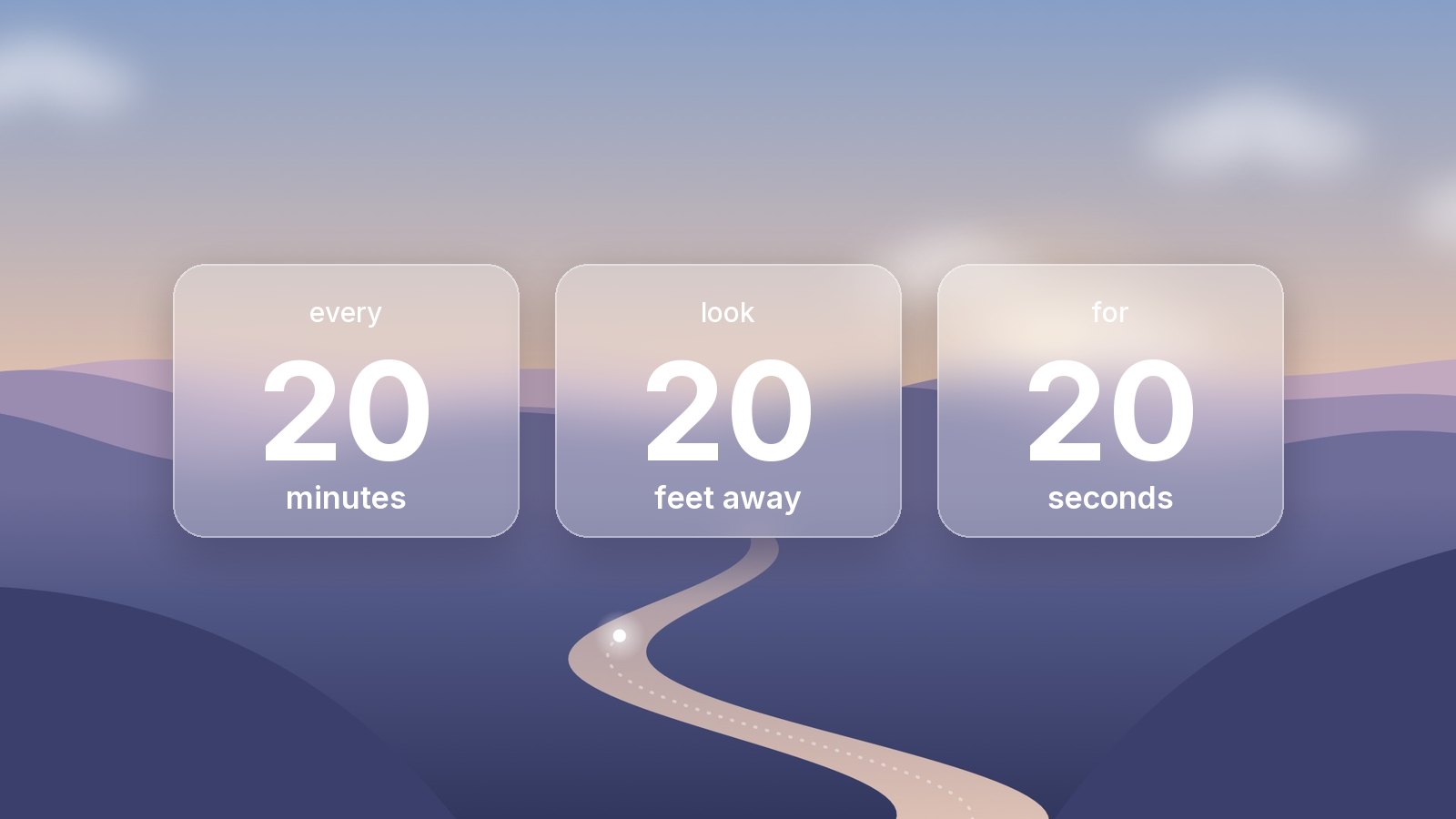
Every 20 minutes, look at something about 20 feet away (around 6 metres) for 20 seconds.
That's it. You don't need to close your eyes, do exercises or leave your desk. You just need to look properly into the distance: out of a window, down a corridor, across the room.
Where it came from
The rule was coined by Dr Jeffrey Anshel, a California optometrist. He has said he came up with it around 1991, while giving talks to companies about eye strain from computer work. The usual advice then was a 15-minute break every two hours, which was hard to fit into a working day. Anshel wanted something short and frequent that people could do without stopping work.
He has also said it was never meant as precise science. It started as a catchy way to remember three habits: blink, breathe and take a break from close work.
Why screens tire your eyes
Looking at something close keeps the muscles that focus your eyes working. Looking far away lets them relax. Hours of close focus, with few chances to look up, is a big part of why your eyes feel tired by the end of the day.
Screens also change how you blink. The American Academy of Ophthalmology says people normally blink about 15 times a minute, and that this can drop by half while looking at a screen. Fewer blinks means drier eyes, which is where the gritty, burning feeling comes from.
The good news, according to the Academy, is that screen use doesn't cause permanent damage to your eyes. Blue light from screens hasn't been shown to harm them either. The discomfort comes from how we use our screens: long stretches of close focus with too little blinking.
Does it work?
The research is mixed, and there isn't much of it.
For: a 2023 study by researchers in Spain and at Aston University in the UK gave 29 computer users software that reminded them to follow the rule. After two weeks, their eye strain and dry eye symptoms had eased. A week after the reminders stopped, the symptoms came back.
Against: another 2023 study, by Johnson and Rosenfield, had 30 young adults read from a tablet for 40 minutes, with and without scheduled 20-second breaks. The breaks made no significant difference to their symptoms.
| Talens-Estarelles and others | Johnson and Rosenfield | |
|---|---|---|
| Who | 29 computer users with eye strain | 30 young adults |
| What | Two weeks of 20-20-20 reminders at their own computers | A 40-minute reading task on a tablet, with and without breaks |
| Result | Eye strain and dry eye symptoms eased, then returned once the reminders stopped | No significant difference in symptoms |
Both studies were small and short, so neither settles it. A fair reading is that the exact numbers aren't magic, but regular breaks from close focus seem to help, and the help lasts only as long as you keep taking them. The hard part is remembering.
How to make it stick
- Look properly far. A wall 2 metres away doesn't give your eyes much of a rest. A window is ideal.
- Blink on purpose. A few slow, full blinks during each break help with dryness.
- Stand up now and then. Every hour or so, take a longer break to stretch and move. Your back and neck will thank you too.
- Set up your screen. The American Academy of Ophthalmology suggests sitting about an arm's length from your screen, with your eyes looking slightly down at it, cutting glare from windows and lights, and matching the screen's brightness to the room.
- Use a reminder. Nobody remembers to look up every 20 minutes while they're busy. A gentle reminder does the remembering for you. On a Mac, Meander is a free one that waits until you're off a call or done with a video before it asks.
If your eyes still bother you after a few weeks of regular breaks, or you get headaches or blurred vision, see an optometrist. An out-of-date prescription is a common cause of eye strain.
This article is general information, not medical advice.
Sources
- Brian Chou, Deconstructing the 20-20-20 rule for digital eye strain, Optometry Times
- American Academy of Ophthalmology, Computers, digital devices, and eye strain
- Talens-Estarelles and others, The effects of breaks on digital eye strain, dry eye and binocular vision: Testing the 20-20-20 rule, Contact Lens and Anterior Eye, 2023
- Johnson and Rosenfield, 20-20-20 rule: are these numbers justified?, Optometry and Vision Science, 2023